

07 Nov Matarazzo
White Stone with a Different Point of View
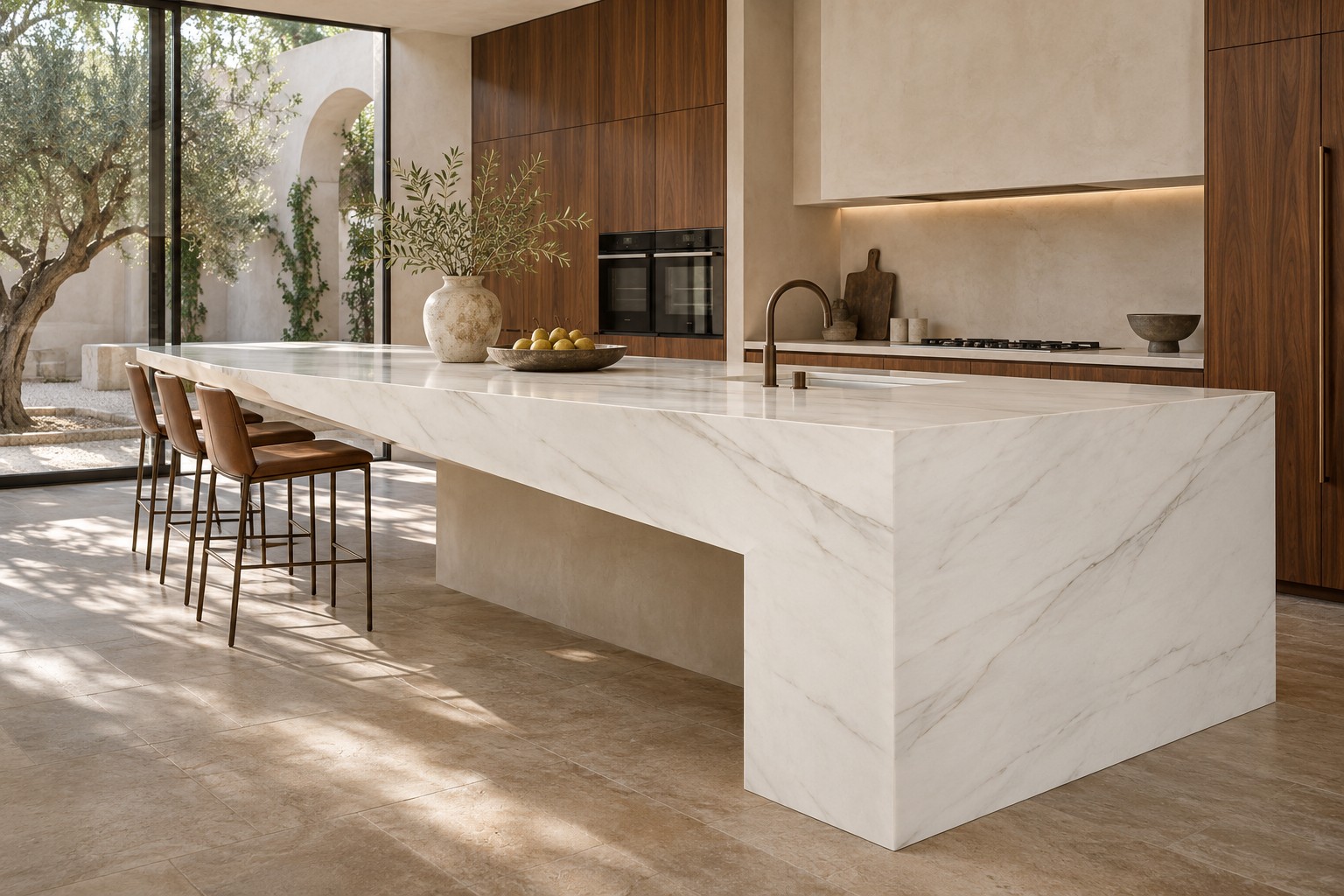
White stone does not have to belong to an all-white room. Against burgundy cabinetry, deep blue lacquer, or brushed steel, Matarazzo’s silver-gray movement takes on a different character—sometimes crisp and architectural, sometimes soft and atmospheric.
The slabs featured here show that range clearly. Broad white areas give the eye room to rest, while branching veins and fractured gray mineral patterns create movement. Some slabs have a quiet, misty appearance; others carry a more expressive drawing that deserves an uninterrupted wall or generous countertop.
From Brazil with a Geological Story
Matarazzo is a Brazilian dolomitic marble, often sold simply as dolomite or Calacatta Matarazzo. Despite the Italian association suggested by “Calacatta,” its origin is Brazil. The name references its visual resemblance to the white background and gray veining associated with Italian Calacatta marble.
Its story begins with ancient carbonate sediments, later transformed into crystalline stone through geological heat and pressure. Brazilian producer Decolores connects its Matarazzo to formations in southern Brazil associated with the ancient Capiru Sea. Exact quarry provenance should be confirmed for the selected material, as commercial stone names can encompass different sources.
The distinction between dolomitic marble and conventional marble matters. Many familiar marbles are predominantly calcite; dolomitic marble contains substantial dolomite, a calcium-magnesium carbonate mineral. That composition can provide greater hardness than common calcitic marble, while retaining the crystalline appearance and acid sensitivity of a carbonate stone. Matarazzo belongs to the marble family; it should not be treated as quartzite.
Let the Individual Slab Guide the Design
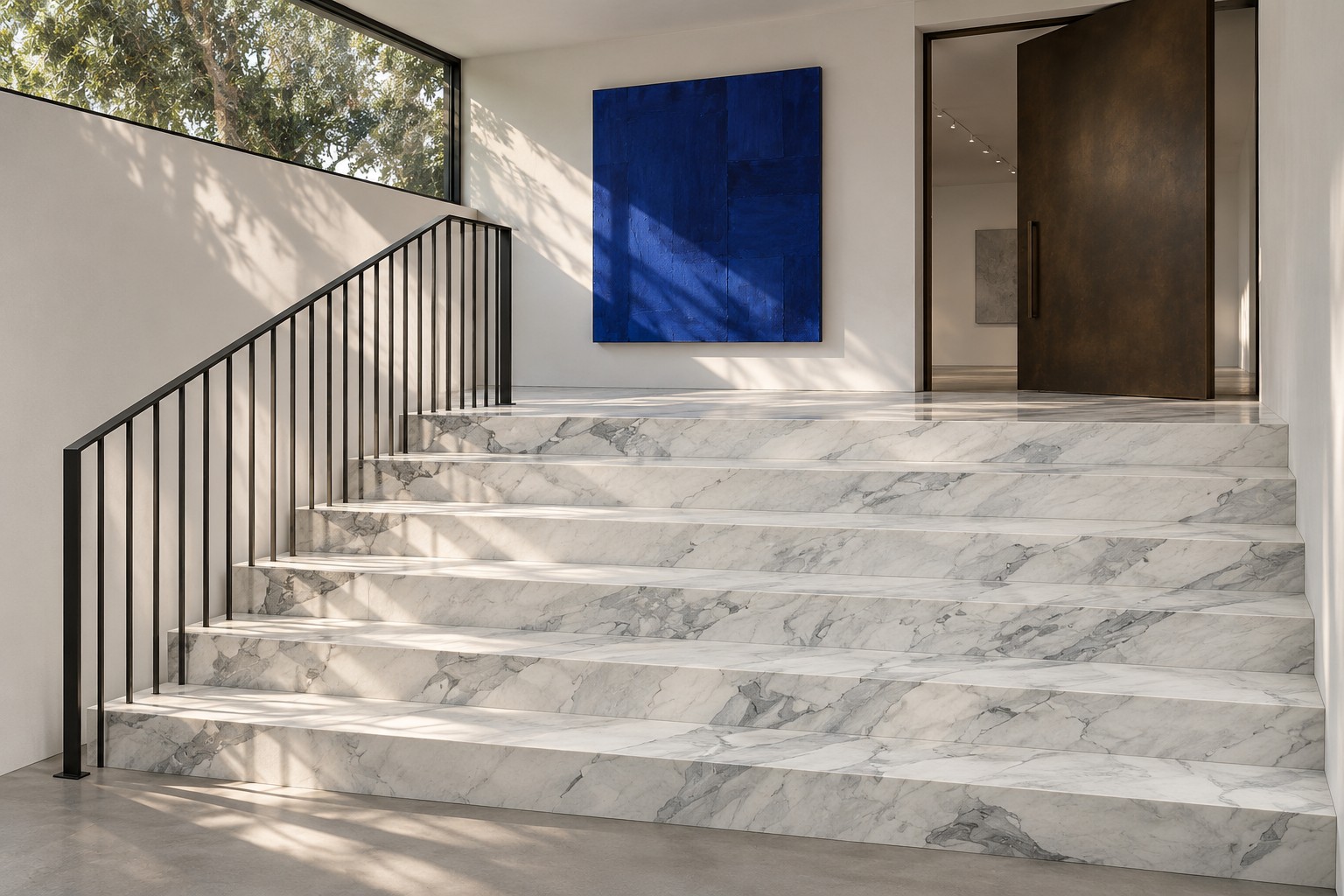
The difference between a quiet Matarazzo slab and a dramatic one can change the entire installation. Fine gray threads suit smaller surfaces where detail is viewed close up. Larger, broken bands need more space to reveal their movement.
Before fabrication, review the full slab and discuss how the cuts will fall. On a backsplash, the strongest vein might sit behind the range; on a vanity, it might travel across the front edge. For furniture, the relationship between the tabletop and supports deserves the same attention as the shape itself.
A polished finish emphasizes reflections and crystalline detail. A honed finish, where available, creates a softer appearance and may make subtle etching less conspicuous, although it does not prevent it.
A Sharper Direction for the Kitchen
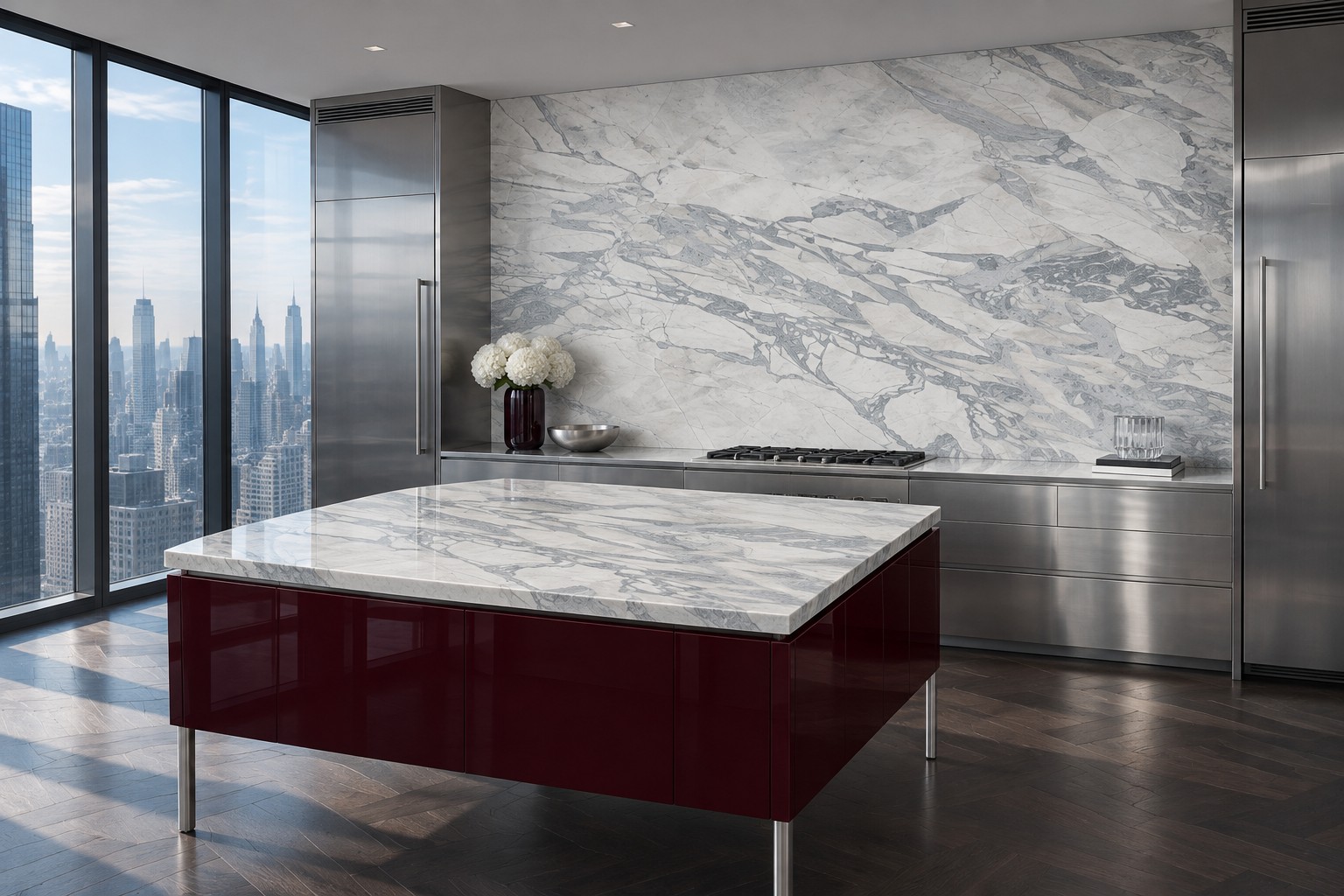
In this penthouse kitchen, Matarazzo connects two very different finishes: reflective stainless steel and rich burgundy lacquer. The steel picks up the cool gray in the veining, while the burgundy adds depth beneath the white countertop.
The island’s slender legs and exposed space underneath give the stone a furniture-like presence. Across the room, the tall backsplash allows the larger mineral patterns to read almost as a wall drawing.
For a similar direction, consider brushed nickel fixtures, smoked oak flooring, and clean-lined cabinetry. Keep nearby patterns restrained so the slab remains legible. A strongly veined selection can carry the backsplash; a quieter section can make the work surface feel more settled.
An Unexpected Place for White Stone
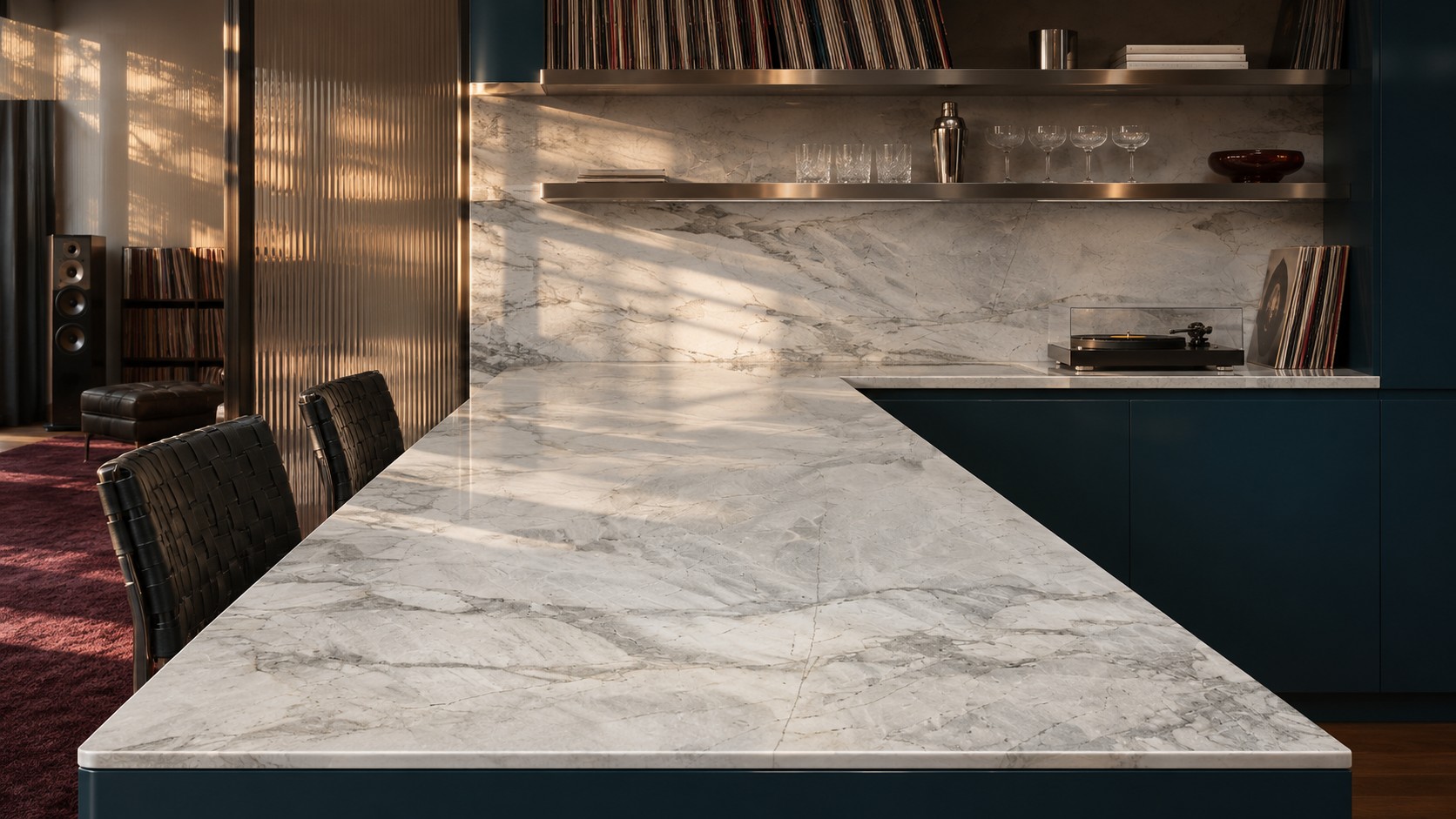
Matarazzo brings brightness to this home bar without disturbing its intimate mood. Deep petrol-blue cabinetry gives the white stone definition, and ribbed glass filters the light rather than opening the room completely.
Here, the countertop and backsplash provide continuity, while metal shelves, woven leather seating, and a burgundy rug introduce contrasting textures. Midnight blue, graphite, tobacco leather, and brushed pewter would all work within this palette.
A home bar also illustrates an important practical consideration: citrus, wine, and cocktail ingredients call for prompt cleanup. Use a preparation tray for drinks and coasters beneath glasses to protect the stone’s finish.
How Maintenance Compares with Regular Marble
Expect a similar care routine, with the possibility of better scratch resistance—not freedom from maintenance. Matarazzo’s dolomitic composition can make it harder than many conventional calcitic marbles, but performance varies with the slab’s mineral makeup and natural structure. It can still scratch, chip, stain, and etch.
| Care consideration | Matarazzo dolomitic marble | Conventional calcitic marble |
| Scratching | Generally harder, but still needs protection | Typically softer and more easily scratched |
| Acid exposure | Acid-sensitive; etching remains possible | Acid-sensitive and prone to etching |
| Daily cleaning | Gentle, pH-neutral stone cleaner and a soft cloth | The same gentle routine |
| Sealing | Assess the selected slab and follow product guidance | Assess the selected slab and follow product guidance |
The key distinction is between staining and etching. A stain involves material absorbed into the stone; an etch is a chemical change to the surface, often seen as a dull patch. An impregnating sealer helps resist staining, but does not make the stone stain-proof or prevent acid etching.
For everyday care:
- Clean with a pH-neutral stone cleaner and a soft microfiber cloth.
- Blot spills promptly, especially citrus juice, vinegar, wine, and oils.
- Use cutting boards, coasters, and trivets.
- Avoid acidic bathroom cleaners, abrasive pads, and scouring powders.
- Follow your fabricator’s advice on sealing; the interval depends on the stone, product, and use.
Matarazzo rewards thoughtful selection. Its white background offers flexibility, but its individual mineral patterns give a project its identity—whether paired with polished metal in a city kitchen or deep color in a private entertaining space.
Explore Matarazzo with Omega Natural Stone, The Stone Boutique. Contact our Farmers Branch showroom to discuss available slabs, finishes, and pairings for your project.